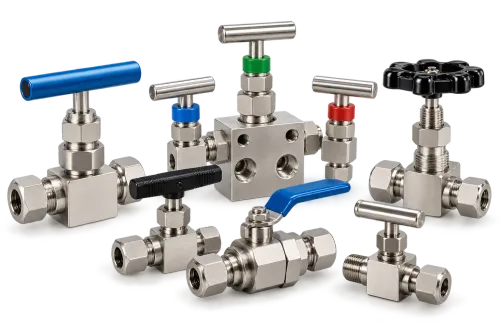
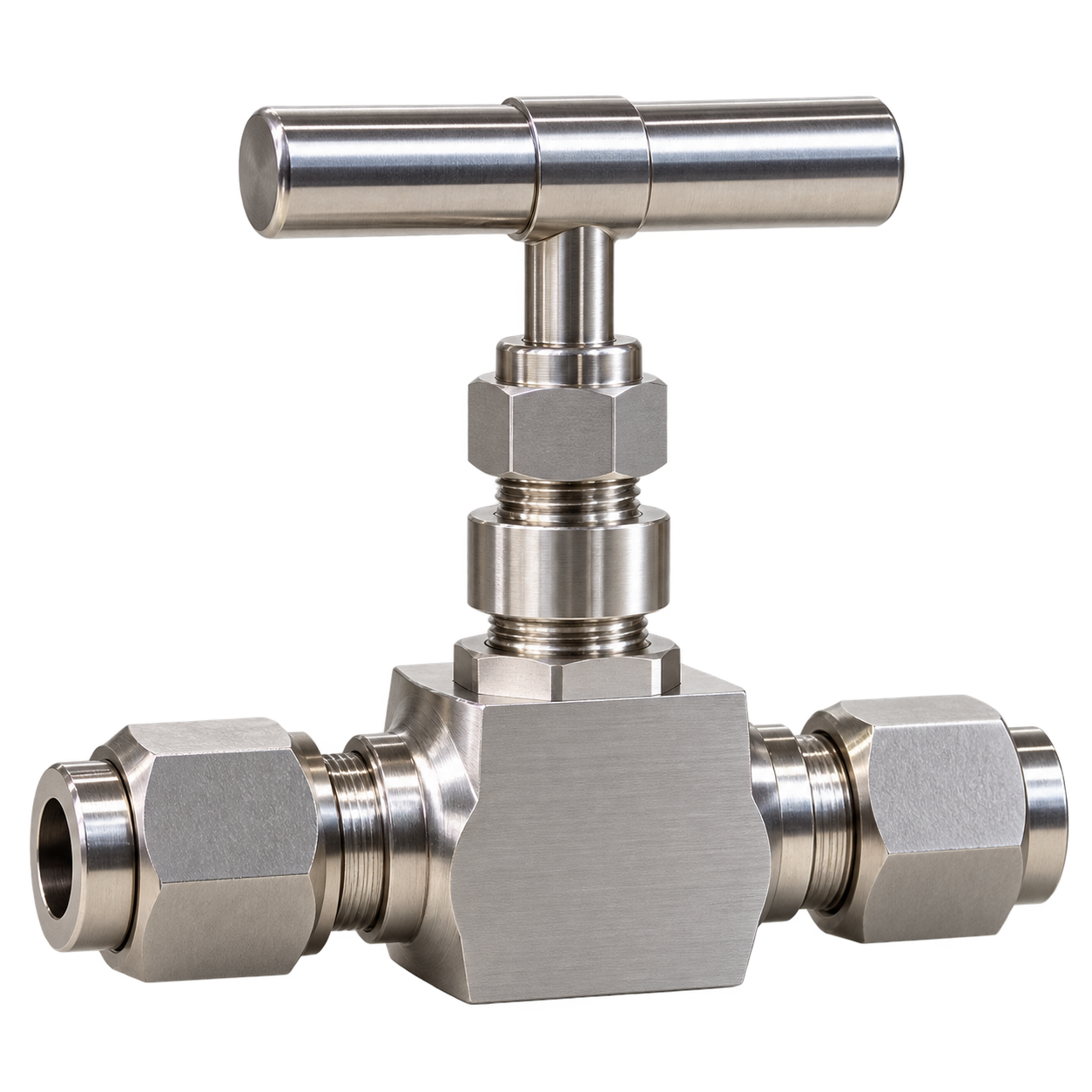
A needle valve can make a small flow change repeatable only when its orifice, stem geometry, materials, rating, and operating conditions match the duty. By the end, you will be able to distinguish throttling from isolation, size the valve by Cv or Kv, identify service limits, and specify the test records a manufacturer must provide.
Key takeaways
- Use needle valves for controlled low-flow throttling, not high-capacity isolation.
- Compare Cv, Kv, operating range, and turndown against your required flow.
- Match body, trim, packing, pressure rating, and temperature rating to the media.
- Request pressure tests, material certificates, calibration data, and traceability records.
How the Tapered Needle Turns Stem Travel into Flow Control
At the seat, a tapered needle enters a small orifice and progressively reduces the annular opening. A fine-pitch stem moves the needle a short distance for each handwheel turn, while a long operating stroke spreads the usable adjustment over many turns. That geometry lets you repeat small flow changes.
A ball or butterfly valve uses a quarter-turn to move a ball bore or disc through its opening. Near the throttling position, a small handle movement can expose a large additional area, causing a sudden flow change. The needle’s gradual area change gives finer control, although its longer travel increases operating time and frictional hysteresis.
Do not assume that handle rotation produces a linear flow increase. Seat angle, needle taper, and the changing passage area make the flow-position curve nonlinear, especially near shutoff. Ask for Cv or Kv data at specified stem positions; that curve reveals the usable control range.
Pipe size alone cannot describe capacity because a needle valve deliberately restricts flow and imposes permanent pressure loss. Select its Cv or Kv from the required flow, inlet and outlet pressures, temperature, fluid density or specific gravity, and viscosity.
An oversized valve may fit the line yet regulate through only a narrow part of its stroke, where small adjustments become difficult to repeat. A needle valve therefore suits low-flow throttling and instrument takeoffs, not replacement of a full-bore isolation valve in a large process line.
Where Fine Throttling Works—and Where the Operating Conditions Fight It
Accurate regulation is strongest in clean, low-flow liquid service where the pressure drop is predictable and the required flow falls within the valve’s controllable stroke.
Use it for throttling service on hydraulic oil, instrument air, and selected steam service. A needle valve is not a universal isolation service valve: its restricted passage creates permanent pressure loss, so a full-port valve is usually better for shutting a large process line.
| Condition | Effect on regulation | Selection or operating response |
|---|---|---|
| Clean liquid service | Stable, repeatable flow through the small orifice | Size by required Cv or Kv, inlet pressure, outlet pressure, temperature, viscosity, and flow—not pipe size |
| High-viscosity liquid | Greater resistance and slower response than water-based sizing predicts | Use the manufacturer’s viscosity correction and check the available pressure drop |
| Solids or abrasive particles | Particles score the seat, jam the needle, and destroy shutoff | Filter the stream or choose hardened, non-galling trim |
| Pulsating flow | Upstream pressure changes make the indicated flow hunt | Add damping or a suitable accumulator and verify control stability |
| Large liquid pressure drop | Local pressure can fall below vapor pressure, causing cavitation or flashing | Check vapor pressure; cavitation collapses bubbles and erodes trim, while flashing carries vapour downstream |
| Gas service | Flow can choke when the downstream-to-upstream absolute-pressure ratio is low | Include absolute pressure, temperature, compressibility, and the valve’s critical-pressure-ratio data |
A gas valve that works at one pressure ratio can lose controllability at another. Oversizing also leaves you operating through a narrow part of the stroke, where small handwheel movements cause disproportionate flow changes.
How to Match the Valve Construction to the Media and Rating
The connection must match the tubing, pipe, access, and leakage tolerance—not merely the nominal bore.
| Connection | Installation and leakage concern | What to verify |
|---|---|---|
| NPT threaded connection | Sealant, thread damage, and over-tightening can cause leaks or body cracking. | Thread standard, engagement length, assembly torque, and pressure rating |
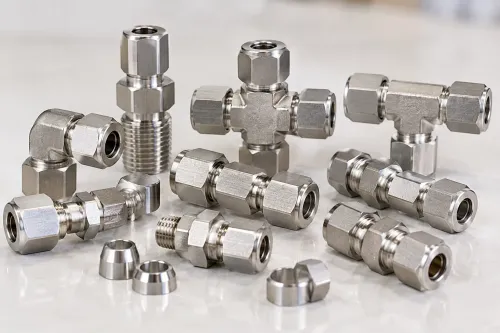
| Compression tube fitting | Tube hardness, ferrule assembly, and vibration determine joint reliability. | Tube outside diameter, material, fitting instructions, and re-make limits |
| Welded end | Permanent attachment reduces joint leakage but demands qualified welding and post-weld cleaning. | Weld dimensions, material compatibility, heat limits, and inspection requirements |
| Flanged end | Gasket selection, bolt load, alignment, and face damage control leakage. | Flange standard, facing, gasket type, bolt pattern, and pressure rating |
Confirm the pressure-temperature rating for the exact body, bonnet, pressure class, and end connection. A valve rated for a given pressure at 20°C may have a lower allowable pressure at elevated temperature; require the manufacturer’s pressure-temperature table and confirm that your connection appears in it.
Select body material for corrosion, temperature, and external environment. Match trim material to velocity, differential pressure, abrasive particles, and cycling; hardened or non-galling trim protects repeated throttling. Choose seat material for chemical compatibility and temperature, then check its resistance to extrusion and particle damage.
Specify packing for the fluid and leakage limit. Use a bellows seal when stem leakage cannot enter the process or atmosphere, and verify its cycle and pressure limits. For oxygen, instrument air, or high-purity service, require documented degreasing, particle control, capped ends, and identification of wetted materials.
How Cv, Kv, Turndown, and Valve Type Determine the Right Choice
Establish controllable range from the valve’s Cv or Kv at your actual operating point, not from nominal pipe size. Calculate the required flow coefficient using flow, pressure drop, fluid density or specific gravity, viscosity, and temperature; then compare it with the manufacturer’s Cv/Kv-versus-stem-position curve.
The valve must pass the actual flow capacity while keeping minimum and maximum required flows inside its stable control region.
A turndown ratio is the maximum controllable flow divided by the minimum controllable flow. An oversized needle valve can have adequate capacity yet offer poor turndown because the process runs through only a few degrees of stem travel near shutoff.
| Option | What it provides | When it applies |
|---|---|---|
| Needle valve | Fine manual throttling at modest flow | Small-bore instrument, sampling, hydraulic, or purge lines |
| Metering valve | Calibrated, repeatable fine adjustment | Low-flow dosing, analytical work, and test equipment |
| Globe valve | Stronger throttling capacity and pressure-drop handling | Larger lines or continuous regulation where pressure loss is acceptable |
| Ball valve | High flow with low resistance, rapid quarter-turn action | Isolation or on/off duty, not precise throttling |
| Control valve | Actuated feedback control with positioned trim | Automatic regulation of pressure, temperature, level, or flow |
Choose a metering valve when repeatable low-flow adjustment matters more than throughput. Choose a globe valve when the required flow exceeds practical needle-valve capacity; choose a ball valve for isolation. Select a control valve when a controller must correct changing process conditions without manual intervention.
What a Manufacturer Must Prove Before You Put the Valve in Service
A signed outline drawing must show the end connection, face-to-face length, pressure class, port size, stem position, and flow direction. Match it against the piping isometric before installation; a “1/4-inch” threaded valve and a “1/4-inch” tube-fitting valve do not share the same assembly method or leakage risk.
Request a valve-specific supply package, not only an ISO 9001 certificate.
| Evidence | What it must identify | What it proves |
|---|---|---|
| Flow-capacity data | Cv or Kv, test medium, pressure drop, temperature, and usable travel range | The valve can deliver the specified flow and control range |
| Pressure test | Test pressure, duration, standard, and valve serial number | The pressure boundary contains the rated pressure |
| Seat leakage test | Test medium, direction, pressure, duration, and measured leakage | The shutoff meets the specified leakage class |
| Material certificate | Body, stem, needle, seat, and packing heat or batch numbers | The wetted materials match compatibility and temperature requirements |
| Traceability record | Serial number linked to certificates and test results | The documents belong to the supplied valve |
For high-purity service, require cleaning instructions and a certificate stating the cleaning level, packaging method, particulate control, and lubricant restrictions. Oxygen cleaning needs explicit confirmation; oil residue, particles, or unsuitable elastomers can cause ignition or contamination.
Installation instructions must cover torque, sealant, tube preparation, flow direction, support, and post-installation testing. For a Pune procurement file, Welcome To S A Enterprise should be assessed on its ability to return this valve-specific evidence rather than a generic certificate.
Frequently asked questions
How does a tapered needle create precise flow control?
The tapered needle enters a small seat orifice and reduces the annular flow opening as the stem advances. Fine-pitch threads and a long operating stroke spread small flow changes across multiple handwheel turns.
Where are needle valves unsuitable?
They work best for low-flow throttling and instrumentation service. Use another valve type when the system needs high flow capacity, rapid shutoff, frequent cycling, abrasive slurry service, or low pressure loss.
How do you match needle valve construction to process conditions?
Check the body and trim materials against the media, then verify pressure and temperature ratings, packing compatibility, end connections, and the required seat-leakage performance.
What do Cv, Kv, and turndown tell you when selecting a needle valve?
Cv and Kv describe flow capacity under defined test conditions, while turndown compares the maximum controllable flow with the minimum stable flow. Use both values with the required operating range and pressure drop.
What documents should a manufacturer provide before commissioning?
Request the pressure-test report, material certificates, dimensional inspection record, identification and batch traceability, seat-leakage result, and calibration or test data when the valve includes instrumentation.