The right instrumentation valve depends on more than body size or a manufacturer’s catalogue label. You need to confirm the valve’s function, wetted materials, connection geometry, pressure-temperature limits, test evidence, and installed control performance before approving a supplier or purchase order.
Key takeaways
- Define whether you need isolation, regulation, venting, bleeding, or check service.
- Match wetted metals, seals, and seat materials to the fluid and temperature.
- Confirm thread type, port orientation, dimensions, and tubing compatibility before ordering.
- Request pressure tests, material certificates, traceability records, and service references.
Start With the Valve Function and the Manufacturer’s Available Range
An instrumentation valve definition should describe a compact valve used to isolate, regulate, vent, bleed, or check pressure and flow in measurement or control tubing. It is not a connection standard.
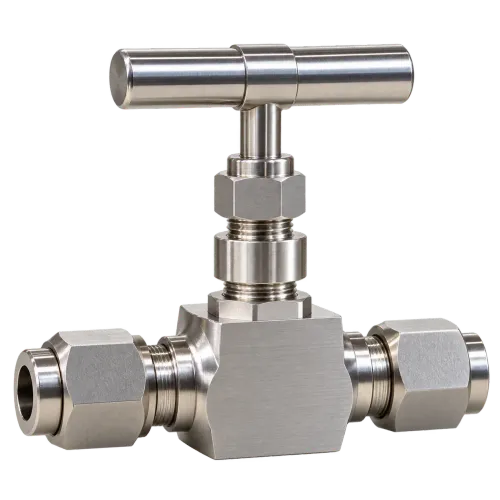
A process isolation valve provides on/off separation; a control valve continuously modulates flow; a needle valve offers fine manual throttling; and a tube fitting only joins tubing.
Confirm that each manufacturer’s available range covers:
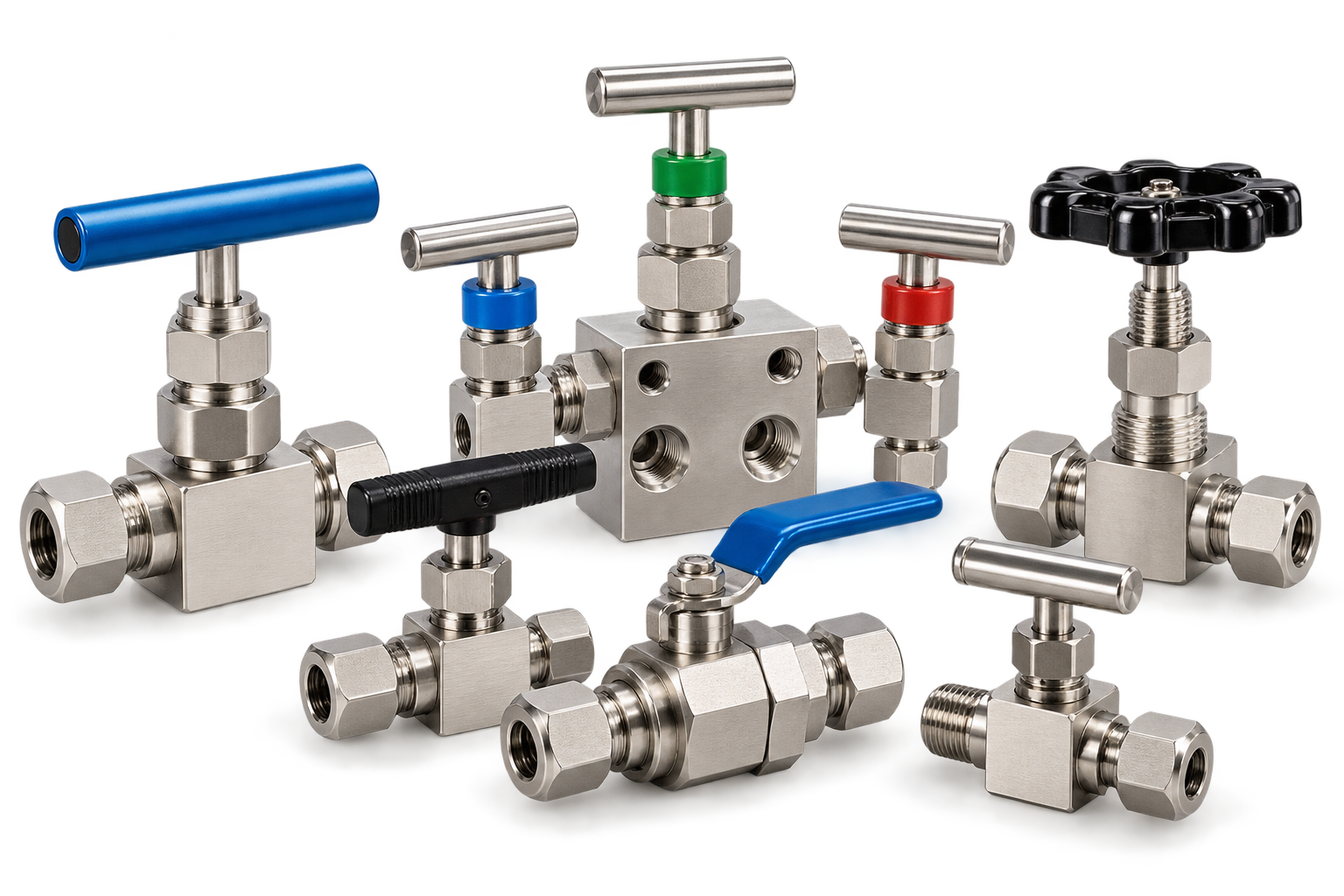
- Needle, ball, check, bleed, gauge, manifold, and monoflange valves
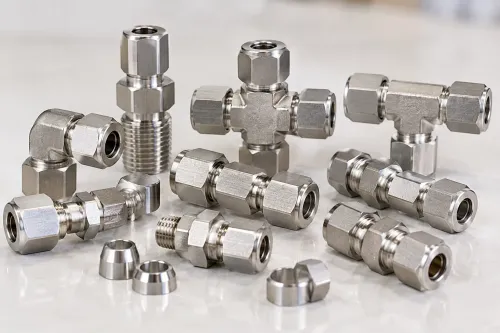
- Single- and double-ferrule tube-fitting ends, NPT, BSPT, BSPP, metric tube, and flange connections
- Required pressure class, port arrangement, bore, operating temperature, and handle or actuator type
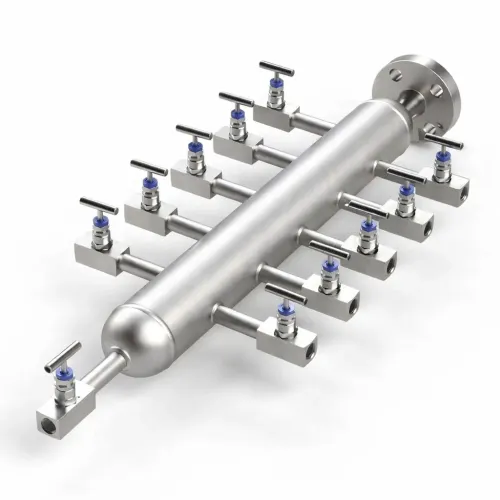
- Five-valve, three-valve, and two-valve manifolds with the isolation, equalization, vent, and drain functions your procedure requires
| Valve type | Primary function | Confirm before comparison |
|---|---|---|
| Process isolation valve | Separates an instrument or process section | Shutoff rating, leakage class, port size, and proof-test pressure |
| Control valve | Modulates flow, pressure, or level | Flow coefficient, installed rangeability, noise, cavitation, flashing, and actuator thrust |
| Needle valve | Fine manual adjustment or restricted flow | Tip and seat design, allowable velocity, pressure drop, and stem cycle life |
| Check, bleed, gauge valve | Prevents reverse flow, vents pressure, or isolates a gauge | Cracking pressure, discharge direction, gauge connection, and safe vent access |
| Manifold or monoflange | Integrates isolation and measurement functions | Port orientation, access, pressure rating, testability, and replacement procedure |
A needle valve manufacturer comparison is meaningful only after these functions and configurations match. Do not treat a visually identical stock valve as equivalent: reconcile its nameplate, configuration code, trim, seat, rating, certificates, and test record with the purchase order.
Match Wetted Materials and Sealing Parts to the Process Fluid
Do not approve a valve from its body alloy alone: the seat, packing, stem seal, bonnet, end connection, and tubing must survive the complete pressure-temperature envelope and the process chemistry.
1. Check the maximum, minimum, cycling, vacuum, and decompression conditions. Compare every pressure boundary with the applicable ASME B16.34 material and construction rating, not just “Class 600.” PTFE, PEEK, graphite, elastomers, and metal seats impose different temperature, leakage, vacuum, and cycling limits.
2. Match the body and trim to composition and hazards. 316 stainless steel suits many general services; 316L stainless steel supports low-carbon welded construction and high-purity systems. Carbon steel can corrode in wet or chemically aggressive streams, while brass valve body material is unsuitable for many ammonia, oxygen, and corrosive services.
Specify Monel or Hastelloy when the documented chemistry demands their nickel-alloy resistance.
3. Treat sour, toxic, chlorine, oxygen, and abrasive service as separate material-selection exercises. For H2S-containing service, require a documented NACE MR0175/ISO 15156 basis covering hardness, heat treatment, environment, and manufacturing restrictions; 316 stainless steel alone proves nothing.
For oxygen or analyzer service, define cleaning agents, hydrocarbon and particulate limits, inspection method, preservation fluid, packaging, and a cleanliness certificate.
4. Confirm fire-safe and traceability evidence for hazardous duty. API 607 or API 6FA testing must cover the specified seat, stem seal, body joint, and actuator arrangement. Require heat-number linkage from pressure-retaining parts to an EN 10204 type 3.1 or 3.2 material certificate; positive material identification verifies alloy chemistry, not mechanical properties or heat treatment.
Verify Connections, Threads, Port Layout, and Dimensional Fit
Verify the valve’s actual end connection and envelope before ordering; nominal size alone is not enough. Specify whether it uses NPT, BSPT, or BSPP pipe threads, metric and UNF threads, compression tube fittings, or socket-weld, butt-weld, or flanged connections.
These interfaces are not interchangeable because their thread form, sealing method, tube outside diameter, and engagement differ.
Before releasing the purchase order, record:
- Thread size, pitch, gender, and sealing method; distinguish tapered NPT or BSPT from parallel BSPP.
- Tube outside diameter, wall thickness, material, and whether the fitting is single-ferrule or double-ferrule.
- Flange standard, nominal size, pressure class, facing, bolt-hole pattern, and gasket arrangement.
- End-to-end or face-to-face dimension, body height, port spacing, and handle or actuator clearance.
- Port orientation, flow direction, vent or drain position, and the required instrument-side connection.
- For welded ends, the socket depth or butt-weld bore, wall thickness, and post-weld access for inspection.
Check the drawing against the existing tubing, manifold, brackets, and nearby equipment. A valve that fits the line can still be impossible to operate if its handle strikes a support or its ports face the wrong way.
Confirm the complete pressure-temperature rating for the body and connection, then compare it with the tubing and fitting rating; a Class 600 marking does not make every attached component Class 600.
Demand Test Records, Material Traceability, and Service Qualification
Ask for a document pack tied to the valve’s serial number, not a generic catalogue certificate. Confirm the ASME B16.34 pressure-temperature rating and require pressure-test results identifying the edition, medium, pressure, duration, and leakage limit under ISO 5208 and API 598.
Request these records before approval:
- EN 10204 3.1 or 3.2 material certificates, with heat numbers traceable from every pressure-retaining part to the supplied valve.
- Positive material identification results, while recognising that PMI does not replace mechanical-property, heat-treatment, or original material evidence.
- A cleaning certificate stating the cleaning method and acceptance results for particles, oil, grease, and other specified residues.
- Calibration records for test equipment, plus nonconformance and design-change records when the service is critical.
| Service | Evidence to demand | What disqualifies the claim |
|---|---|---|
| Fugitive emissions | ISO 15848 classification, leakage and endurance classes, packing specification, and the applicable API 624 report | “Low emission” wording without a type-test report |
| Fire-safe | API 607 or API 6FA report covering the specified seat, stem seal, body joint, and actuator arrangement | A test on a different construction |
| Sour service | NACE MR0175 ISO 15156 material-selection basis, hardness, heat-treatment, and manufacturing records | A generic “316 stainless steel” or “sour service” statement |
API 624 applies to rising-stem valves with graphite packing; quarter-turn valves need the correct qualification basis. Welcome To S A Enterprise can help consolidate supplier records, but you must verify that production matches the tested configuration.
Check Installed Control Performance, Manifold Design, and Lifecycle Fit
A valve that fits the line can still control badly. Compare installed behavior, not nominal size: request an IEC 60534-2-1 valve sizing calculation showing pressure drop, fluid density, vapor pressure, choking risk, and gas or vapor flow conditions.
Check the rated flow coefficient Cv across the operating range; an oversized valve hunts near its seat, while an undersized valve stays nearly closed and loses controllability.
Ask the manufacturer to document these application checks:
- Compare predicted capacity, rangeability, actuator or stem thrust, and allowable velocity at minimum, normal, and maximum flow.
- For severe pressure letdown, require calculations for cavitation, flashing, valve noise, vibration, trim erosion, and unstable control. A passed pressure or leakage test does not prove reliable service.
- Treat a five-valve manifold as a functional assembly, not a safety guarantee. Confirm upstream and downstream isolation, equalization, vent or drain capability, pressure rating, port orientation, operating access, and the ability to isolate and test it under your procedure.
- Request the actual packing and emissions qualification for fugitive-emission service, rather than accepting “low emission” wording.
Lifecycle fit depends on evidence after delivery. Check design-change control, calibration traceability, nonconformance handling, subcontracted machining or testing, serial-number traceability, spare-trim availability, and the supplier’s ability to reproduce the tested configuration. ISO 9001 supports process discipline; it does not prove the valve suits your service.
Frequently asked questions
What should you check first when choosing an instrumentation valve manufacturer?
Define the valve function— isolation, regulation, venting, bleeding, or check service—then confirm the manufacturer offers the required valve type and range.
How do you match instrumentation valve materials to a process fluid?
Compare the fluid’s composition, pressure, temperature, and compatibility risks with the valve body, trim, seats, packing, and elastomer materials.
Which connection details must you verify before ordering?
Check thread standard, size, pressure class, port layout, end connections, tubing dimensions, mounting orientation, and face-to-face or envelope dimensions.
What records should an instrumentation valve manufacturer provide?
Request pressure and leak-test results, material certificates, heat or batch traceability, inspection documents, calibration records when applicable, and evidence of service qualification.
How should you assess lifecycle fit for instrumentation valves?
Review installed control performance, manifold design, access for maintenance, spare-part availability, seal replacement needs, operating limits, and total ownership effort.