A threaded joint can look tight while still having the wrong thread form, insufficient engagement, damaged zinc protection, or a hidden load from misaligned pipe. By checking the standard, dimensions, thread geometry, installation method, and service conditions, you can determine whether a GI ISI threaded fitting will form a dependable connection or whether another joint type is safer.
Key takeaways
- Treat GI as a corrosion-protective coating, not a thread or pressure specification.
- Confirm pipe size, thread form, material, and pressure class before purchase.
- Do not mix BSPT, BSP, and NPT threads without verified compatibility.
- Use welded, flanged, or grooved joints when threaded connections are unsuitable.
What GI and ISI Mean on a Threaded Fitting
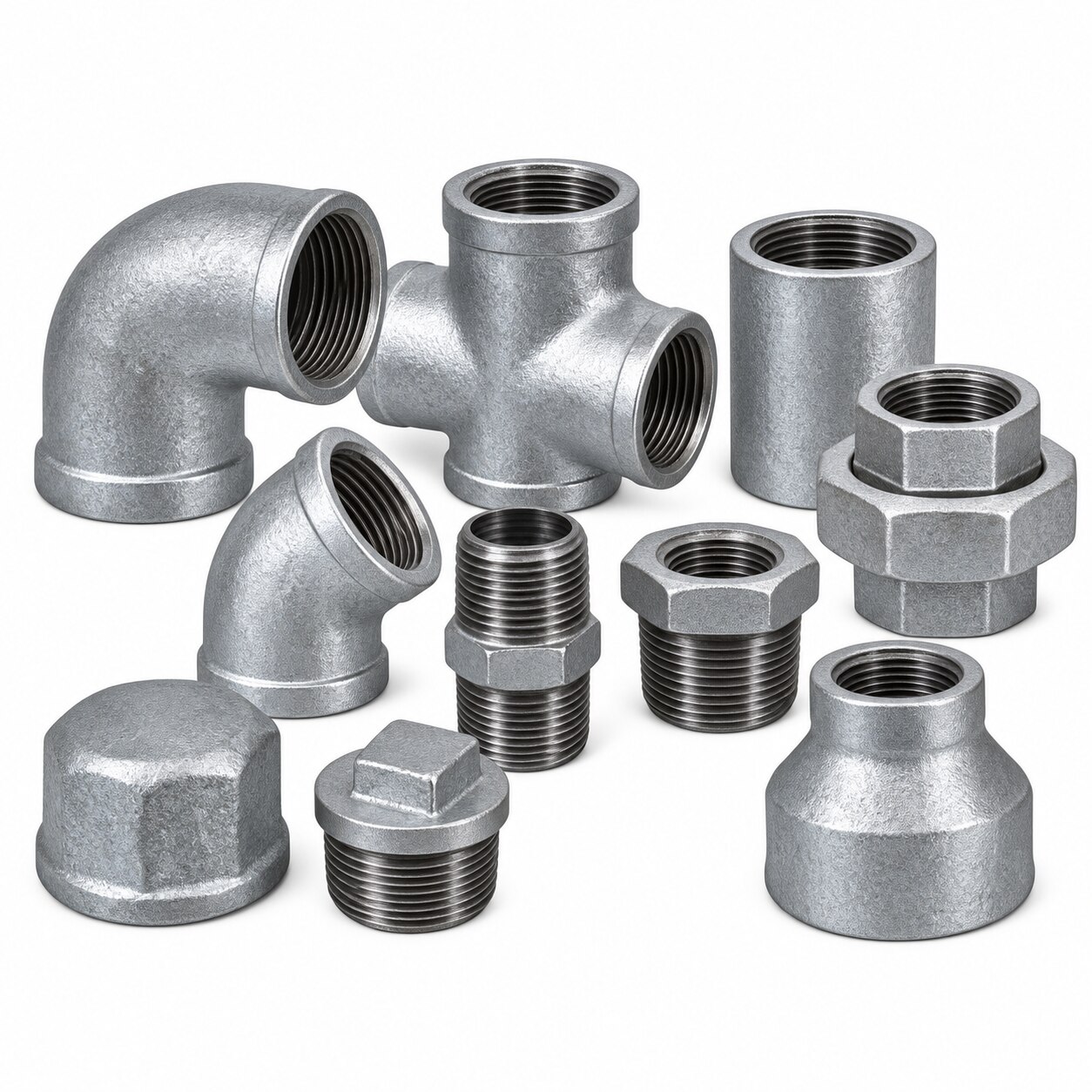
GI describes the zinc-coated finish used to protect a fitting from external corrosion; it does not define the thread, size, pressure class, or interchangeability. In GI threaded fittings, the body is commonly malleable cast iron with a galvanized coating, so “GI” alone is not a complete technical specification.
The ISI mark confirms that the manufacturer holds a BIS licence to mark the product against a specified Indian Standard.
For this fitting type, ask whether the stated standard is IS 1879 malleable cast iron pipe fittings, and check the marking or certificate for the standard number and BIS licence number, shown as a CM/L number.
The ISI mark does not confirm that every galvanized fitting has the same dimensions or will mate with every pipe.
Before accepting a fitting, verify:
- The applicable standard and product description
- Nominal bore and matching pipe outside diameter
- Thread designation, such as ISO 7-1 R, Rp or Rc, rather than only “BSP” or “GI thread”
- Pressure class and end configuration
- Galvanizing requirement and coating condition
A BIS licence does not turn a Class 150 or Class 300 fitting into a universal pressure rating. The complete assembly remains limited by the lowest-rated component, the pipe wall left after threading, operating temperature, fluid compatibility, and the governing design code.
Match the Fitting to the Pipe, Thread and Pressure Class
Before ordering, make the nominal bore, pipe outside diameter, thread size, thread form, material, and pressure class agree with the piping specification. A GI ISI marking does not make every galvanised threaded fitting interchangeable; confirm the applicable Indian Standard and the BIS licence scope for that fitting type.
| Detail to match | What to verify | What goes wrong if it does not match |
|---|---|---|
| Nominal bore and pipe outside diameter | Check the pipe standard, wall thickness, and actual outside diameter against the fitting size | A fitting can have the same nominal bore yet fail to suit the pipe’s outside diameter or wall |
| Thread size and form | Specify ISO 7-1 R, Rp, or Rc, or the exact NPT designation; do not write only “BSP” or “GI thread” | A joint can assemble with partial engagement and still leak |
| Pressure class of threaded fittings | Identify the stated class, such as ASME B16.3 Class 150 or Class 300, and its pressure-temperature limit | The class is not a universal working pressure in bar |
| Material and coating | Confirm malleable iron or the specified material, galvanising requirement, and service compatibility | Corrosion, coating damage, or chemical attack can shorten service life |
| End configuration | Match male, female, union, elbow, tee, reducer, or valve connection to the drawing | Forced alignment loads the joint and connected equipment |
Finally, check the pipe schedule or minimum wall after threading. Threading removes wall material, so the complete assembly is limited by the weakest component, temperature, fluid, corrosion allowance, and design code—not the fitting class alone.
Tell BSP, BSPT, NPT and Parallel Threads Apart
A joint can screw together and still leak when the pipe and fitting use different thread forms. Confirm the thread designation before assembly; do not rely on nominal size, appearance, or the label “BSP thread.”
| Thread form | Identification and sealing implication |
|---|---|
| BSP thread | A general trade description that is incomplete by itself; confirm whether the thread is parallel or tapered. |
| BSPT | Common designation for a tapered British pipe thread; verify the exact standard and mating thread. |
| NPT thread | American tapered pipe thread with a different angle and profile from ISO 7 pipe threads; do not mate it with BSPT. |
| ISO 7-1 R Rp Rc threads | R is external taper, Rp is internal parallel, and Rc is internal taper; specify the complete designation on drawings and orders. |
Use a thread gauge and compare the pitch, flank profile, diameter, and taper with the manufacturer’s data when the pipe and fitting come from different sources. An NPT thread forced into a BSPT fitting can feel tight while leaving poor flank contact and a spiral leak path.
Reject parts with crossed threads, damaged crests, or an engagement that bottoms out before the intended position. Apply a compatible pipe-thread sealant after confirming the fluid, temperature, pressure, and service approval, such as potable-water, fuel-gas, oxygen, or chemical compatibility. Sealant cannot correct mismatched threads or compensate for inadequate engagement.
Install, Inspect and Pressure-Test the Threaded Joint
A sealed threaded joint starts with clean, aligned threads and controlled tightening—not sealant alone. Inspect both parts for damaged crests, stripped threads, dirt, burrs, or zinc flakes, then confirm the fitting turns by hand without cross-threading.
- Support and align the pipe before assembly; never use the fitting to pull misaligned pipe into position.
- Clean the male and female threads with a brush and solvent compatible with the service, without scraping away sound galvanising.
- Check thread engagement by hand. Stop if the fitting binds early, bottoms before the intended position, or leaves visibly poor flank contact.
- Apply a compatible thread sealant or PTFE tape rated for the fluid, temperature, pressure, and any required potable-water, fuel-gas, oxygen, or chemical service. Keep sealant and tape out of the pipe bore, and leave the first thread clear.
- Tighten with a wrench on the fitting body while protecting the galvanised surface with suitable padded jaws. Stop at the specified position; over-torquing can crack the fitting, deform threads, or damage the coating.
- Inspect the finished joint for exposed damaged metal, skewed alignment, excessive tightening, and signs that the fitting was driven beyond its usable position.
After assembly, isolate the section and pressure-test it with the specified test medium and pressure from the approved procedure. Raise pressure gradually, hold for the required period, and inspect every joint for seepage or pressure loss. Depressurise before correcting a leak; never tighten a pressurised joint.
Repair exposed steel with a compatible zinc-rich coating after preparation.
Know When Threaded Fittings Are the Wrong Connection
Choose another connection when the line has severe vibration, repeated thermal movement, cyclic loading, difficult access, or a permanent low-maintenance requirement. Threaded fittings are practical for accessible small-bore services, but threading removes pipe-wall material and concentrates stress at the joint.
| Connection | Choose it when | Main advantage |
|---|---|---|
| socket-weld connection | Small-bore, high-integrity process piping needs a permanent joint | Strong joint with no exposed threads |
| butt-weld connection | Larger lines, high temperature, high pressure, or repeated cycling demand a continuous joint | Lowest leak risk and fewer crevices |
| flanged connection | You must remove a valve, instrument, spool, or equipment connection for inspection or maintenance | Bolted disassembly without cutting the pipe |
| grooved connection | You need rapid installation, controlled flexibility, or easier field replacement on compatible piping | Mechanical coupling avoids field welding |
| compression connection | Clean tubing or thin-wall pipe needs a demountable joint without heat or threading | Installation with hand tools and no hot work |
Do not tighten a threaded fitting to pull misaligned pipe into place. Correct the supports and alignment first; otherwise bending loads can damage the seal, fitting, valve, or equipment nozzle. Select the alternative from the piping code, temperature, pressure, fluid, pipe wall, and required restraint—not from nominal size alone.
When comparing options, Welcome To S A Enterprise can help separate a threaded requirement from a butt-weld, flange, or compatible fitting schedule so the connection type matches the complete assembly.
Related product
 | VS Threaded Fittings VS Threaded Fittings View product → |
Frequently asked questions
What do GI and ISI mean on a threaded fitting?
GI identifies the galvanized iron finish, usually a zinc coating over malleable cast iron. ISI refers to conformity with an applicable Indian Standard and must be verified against the marking and documentation; neither marking alone defines thread type or pressure class.
How do you match a threaded fitting to a pipe?
Check the nominal size, pipe material, thread form, thread direction, fitting material, and pressure class. Confirm that the fitting’s specification matches the pipe and service conditions before installation.
How can you tell BSP, BSPT, and NPT threads apart?
BSPT and NPT are tapered threads, but their thread angles and dimensions differ. BSP parallel threads maintain a constant diameter, while BSPT narrows along the length. Use verified drawings, gauges, or manufacturer specifications instead of relying on visual inspection.
How should you install and pressure-test a threaded joint?
Clean and inspect both threads, apply a compatible sealant, tighten without over-torquing, and support the connected pipe. Test the completed system with the specified test medium and pressure, then inspect for leaks.
When are threaded fittings the wrong connection?
Choose another connection when vibration, thermal cycling, large pipe sizes, severe corrosion, high pressure, frequent disassembly, or a cleanliness requirement makes threaded joints unreliable or difficult to inspect.