The label “VS” does not by itself identify a universal thread standard, pressure class, or material grade, so treating every VS threaded fitting as interchangeable can create leaks, damaged threads, and difficult maintenance. By the end, you will be able to interpret the designation, match fitting geometry and thread standards to an industrial service, verify compatibility, and specify the documents and materials needed for a sound purchase.
Key takeaways
- Confirm the manufacturer’s definition of “VS” before selecting a fitting.
- Choose elbows, tees, unions, or adapters according to the pipe layout.
- Match male and female threads, seal method, and installation direction.
- Check material, pressure class, temperature, fluid, and procurement documents.
What “VS” Means Before You Specify a Threaded Fitting
“VS” is not, by itself, a recognised technical standard for threaded fittings. The VS threaded fittings meaning depends on the manufacturer: it may identify a product series, VS threaded fittings design, connection configuration, or company-specific code.
Do not treat VS as a substitute for ASME B16.11, ASME B1.20.1, or ISO 7-1. Ask the manufacturer to define the designation on a drawing or datasheet, then verify the following details:
| Item | Confirm | Why it matters |
|---|---|---|
| Construction | Forged, cast, machined from bar, or fabricated | Product form controls material and inspection requirements |
| Ends | Male, female, or mixed | Determines how the fitting connects to adjoining components |
| Threads | Parallel or taper; named thread standard | Prevents incompatible mating and sealing |
| Rating | Pressure class and pressure-temperature table | Nominal size alone does not establish allowable pressure |
| Material | Exact grade and product standard | “Steel” or “stainless steel” is not sufficient |
| Dimensions | Nominal size, bore, wall thickness, and tolerances | Prevents an incorrect replacement |
| Identification | Standard marking, heat number, or batch number | Supports verification and traceability |
Forged threaded fittings are commonly specified to ASME B16.11, including pressure classes such as 2,000, 3,000, and 6,000, but the standard does not replace a material specification such as ASTM A105/A105M or ASTM A182/A182M.
A fitting is not suitable because its outside appearance or nominal size matches another threaded fitting. Confirm the complete specification, thread gauges, marking, certificates, and traceability before approval.
Where These Fittings Work—and Which Shape Fits the Layout
Industrial applications of VS threaded fittings include compressed-air lines, water service piping, utility piping, instrumentation connections, hydraulic or pneumatic connections, and low-pressure process services. They suit small-bore lines and maintenance work where welding, hot work, or post-weld treatment is impractical.
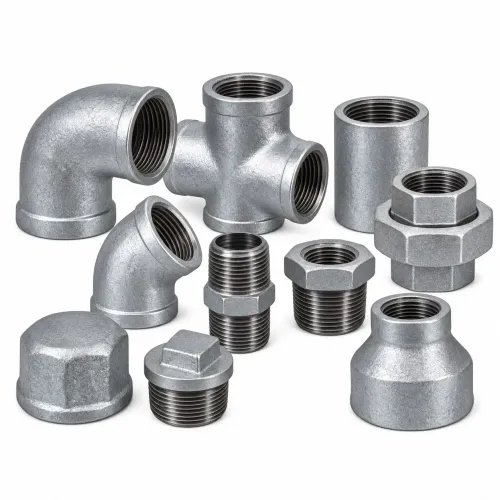
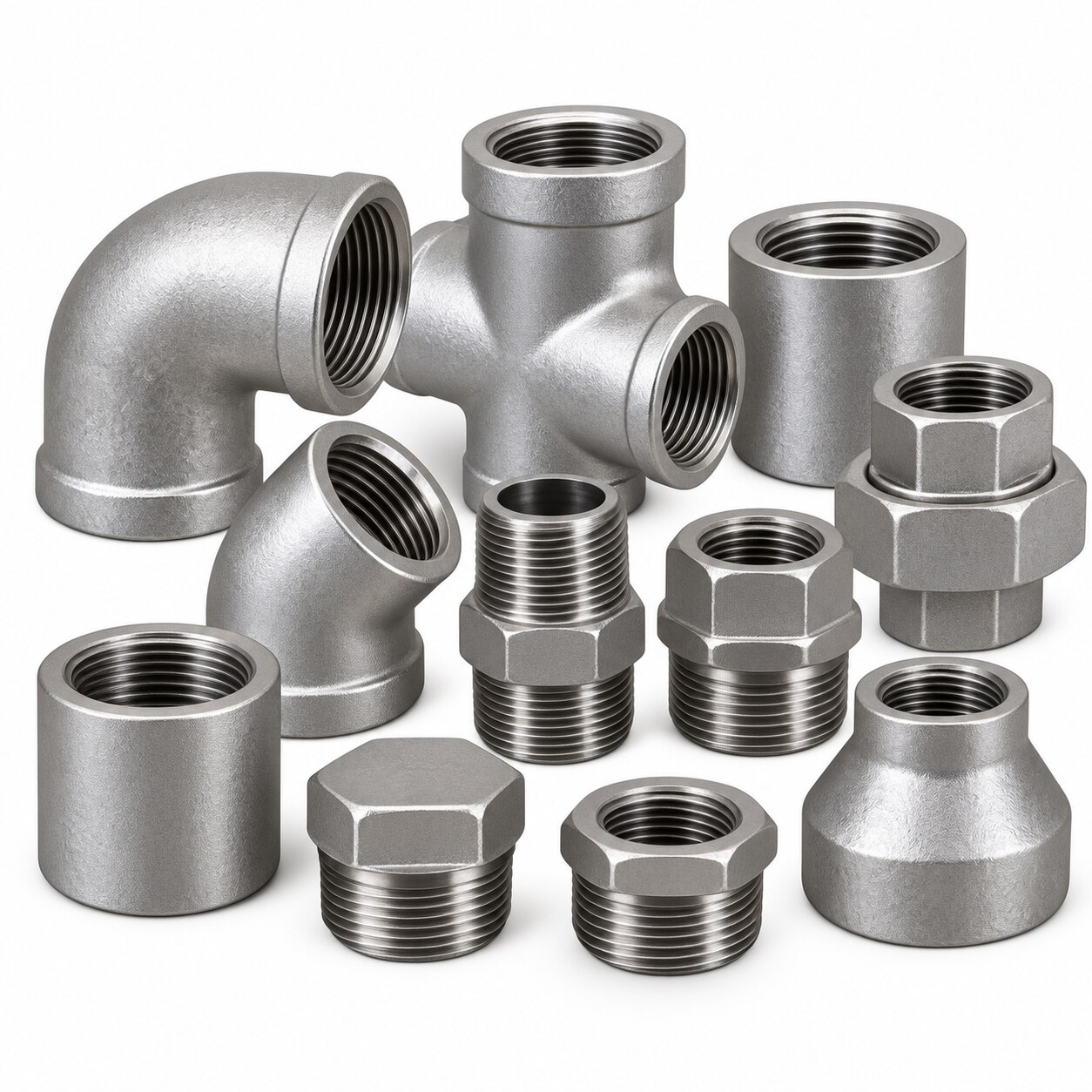
A male thread enters a female thread, while sealant or a gasket provides the joint seal according to the connection design. Select the shape from the layout, not appearance:
| Shape | Function | Choose it for |
|---|---|---|
| Elbow | Changes direction | Routing a line around equipment or between different elevations |
| Tee | Creates one branch | Adding a drain, gauge, valve, or secondary line |
| Cross | Creates two branches | Four-way distribution where space and flow arrangement permit |
| Coupling | Joins two female ends | Connecting two externally threaded pipe sections |
| Socket | Female-to-female joining | Joining compatible male-threaded components in a compact layout |
| Union | Separates a joint without pipe rotation | Removing a valve, filter, instrument, or machine |
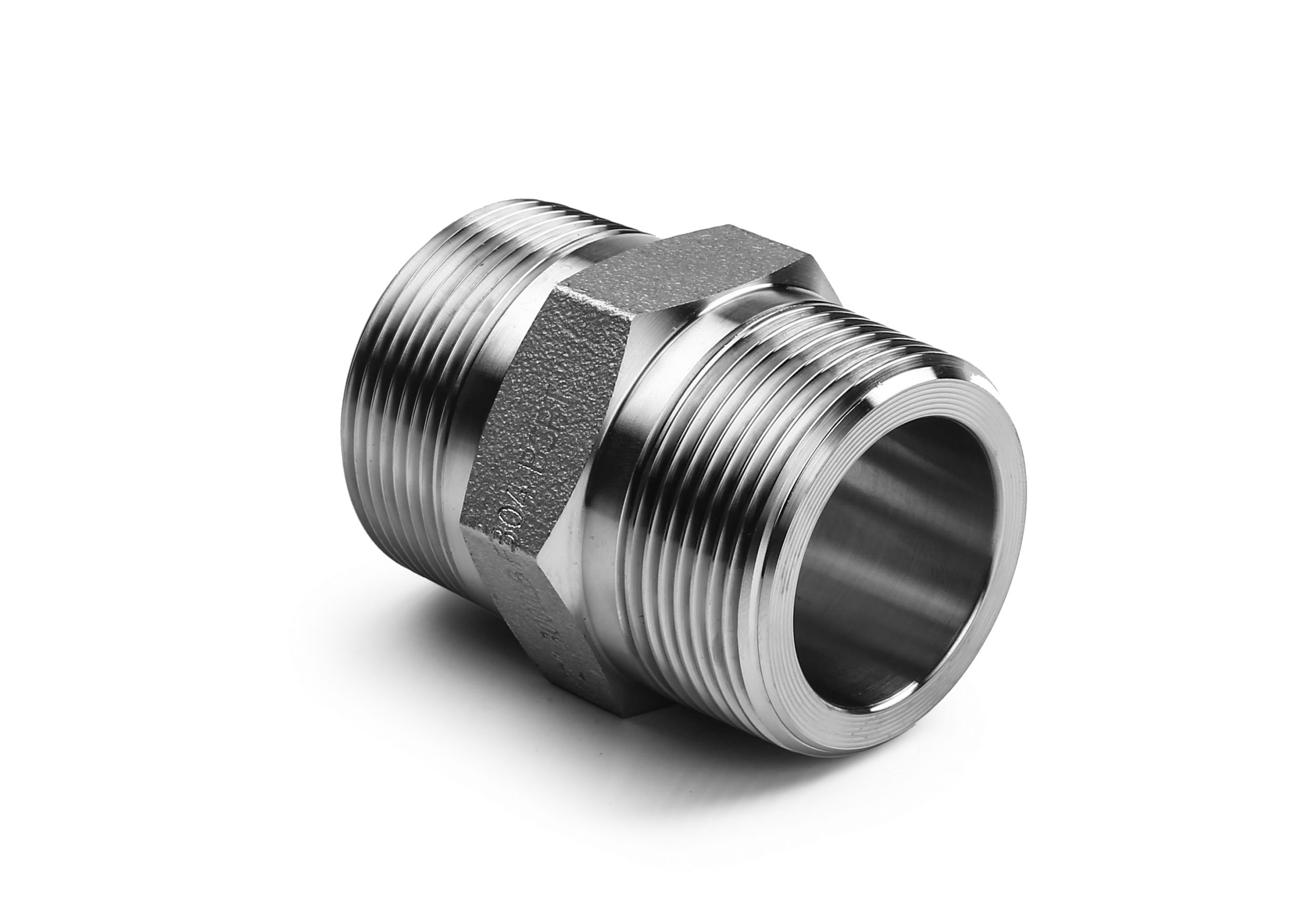
| Nipple | Short male-to-male connection | Bridging two female fittings over a short distance |
| Reducer | Changes nominal size through the fitting | Connecting different pipe sizes inline |
| Bush | Reduces a female opening to a smaller male thread | Adapting a larger fitting to a smaller branch |
| Plug | Closes a female port | Sealing a tapped outlet for later access |
| Cap | Closes a pipe’s male end | Terminating an open pipe end |
A union cannot rescue a poor layout: opposing thread directions, insufficient wrench clearance, or restricted access can make assembly impossible. Threaded fittings lose appeal as diameter, vibration, thermal cycling, leakage consequences, or service severity increase; welded, flanged, or purpose-designed tube connections then offer better control.
How to Match Threads, Seals, and Installation Direction
Prevent a mismatch by recording the standard, nominal size, pitch, flank angle, thread form, taper, and sealing method before ordering. Outside diameter alone cannot identify a thread: similar diameters can have different pitches and profiles.
| Thread system | Identify it by | Taper and sealing |
|---|---|---|
| NPT, ASME B1.20.1 | Nominal pipe size, pitch, 60-degree flank angle, tapered form | Tapered interference plus compatible sealant |
| BSP vs BSPT | BSPP is parallel; BSPT is tapered; both use 55-degree Whitworth form | BSPP needs a sealing element; BSPT uses compatible taper sealing |
| ISO 7-1 | R external taper, Rc internal taper, or Rp internal parallel; 55-degree Whitworth form | Match the designated mating form and seal |
| Metric pipe threads | M nominal diameter and pitch, usually 60-degree form; verify whether parallel or tapered | Use the specified gasket, O-ring, face, or sealant |
NPT’s 60-degree form is not interchangeable with the 55-degree Whitworth form used by ISO 7-1 pipe threads, even when nominal sizes look similar. Mixing them causes leakage, damaged flanks, or incomplete engagement.
Parallel and taper threads seal differently. Parallel threads need a gasket, O-ring, or designed metal-to-metal sealing face; thread sealant cannot make a mismatched joint safe.
- Check the marked nominal pipe size and thread direction, including right- or left-hand orientation.
- Measure pitch and diameter with a thread gauge and caliper, then test a known mating sample.
- Confirm engagement length, sealing face, and sealant compatibility, especially for oxygen, chemicals, high temperature, or contaminated service.
How Material, Pressure Class, and Service Conditions Change the Choice
Safety depends on the fluid, minimum and maximum temperature, design pressure, cycling, corrosion environment, and connection loads—not nominal size alone. An ASME B16.11 threaded fitting pressure class of 2,000, 3,000, or 6,000 does not replace the manufacturer’s pressure-temperature table or a piping-code design check.
Material selection changes with service:
| Material | Corrosion and chemistry | Temperature, pressure, and exposure |
|---|---|---|
| Carbon steel | Economical for dry air, hydrocarbons, and compatible utilities; rusts with water, chlorides, acids, or wet deposits | Strong for rated conditions, but external corrosion can develop beneath insulation or sealant residue |
| Galvanised steel | Zinc helps atmospheric protection; galvanised fittings corrosion accelerates after coating damage and in acidic, alkaline, or high-temperature service | Do not assume the zinc coating suits process chemistry, temperature, or pressure |
| Stainless steel | Resists many fluids, but chlorides can cause pitting and crevice corrosion; threads can gall | Specify grade and heat treatment; use clean tooling and a suitable compound where service permits |
Specify ASTM A105/A105M carbon-steel forgings or ASTM A182/A182M stainless and alloy forgings, not merely “steel” or “stainless steel.” Request the heat number, chemical analysis, mechanical properties, heat treatment, dimensional inspection, thread-gauge results, and PMI where required. H2S exposure may require NACE MR0175/ISO 15156 compliance.
Choose welded or flanged joints when leakage consequences, vibration, or cyclic loading demand tighter control. Double-ferrule or cone-and-thread connections suit controlled instrumentation sealing better than a helical threaded path.
For stainless assembly, remove dirt, prevent crossed threads, use clean compatible tooling, and verify compound compatibility with oxygen, chemicals, temperature, and contamination.
A Procurement Checklist for Comparing VS Threaded Fittings
Put every identifying field on the enquiry or purchase order; “VS threaded fitting” and nominal outside diameter are not enough.
- Geometry: fitting shape, nominal size, bore or schedule where relevant, and male or female end.
- Connection: thread standard, thread direction, parallel or taper form, seal type, and applicable standard.
- Service: pressure class, temperature and pressure range, fluid, corrosion environment, and required corrosion allowance.
- Material: exact grade, product form (forged, cast, bar-machined, or fabricated), marking, batch or heat traceability, and required certificates.
- Evidence: request a threaded fitting datasheet, drawing, pressure-temperature rating, installation instructions, and thread-gauge or dimensional inspection evidence. Specify whether you need a material certificate vs compliance certificate, plus chemical analysis, mechanical properties, heat treatment, or PMI records.
| Uncertain detail | Ask the supplier to confirm | Why it matters |
|---|---|---|
| Application | Fluid, temperature, pressure, corrosion environment | Prevents an unsuitable alloy or rating |
| Connection | Thread gauge result, engagement, sealant, direction | Stops incompatible threads and leakage |
| Product identity | Drawing, marking, heat number, product form | Proves what was supplied |
Also require confirmation that a pipe-threaded adapter is not being substituted for a tube fitting. Welcome To S A Enterprise can help a Pune-area industrial piping supplier’s customer compare available configurations, materials, and documents for utility, instrumentation, or process piping; base the decision on verified specifications, not a catalogue label.
Related product
 | VS Threaded Fittings VS Threaded Fittings View product → |
Frequently asked questions
What does “VS” mean on a threaded fitting?
“VS” is not a universal threaded-fitting standard. Confirm whether it identifies a product series, connection configuration, design, or manufacturer code.
How do you choose the right threaded fitting shape?
Use elbows to change direction, tees to branch a line, unions to enable disassembly, and adapters to transition between connection types.
How do you match threads and seals on a threaded fitting?
Verify thread type, nominal size, gender, pitch, and installation direction. Use a compatible sealing method such as thread sealant or tape for the specified service.
Which service conditions affect threaded fitting selection?
Select the material and pressure class for the fluid, operating temperature, corrosion exposure, pressure, vibration, and required joint life.
What documents should you request when comparing VS threaded fittings?
Request the manufacturer’s code definition, dimensional drawing, material grade, pressure-temperature rating, thread standard, inspection records, and traceability details.